What Is the Point? How Meditation and Self-Inquiry Can Help You Find Your Purpose

Most people don't ask "what is my purpose in life?" from a place of deep philosophical curiosity. They ask it at 11pm after a day that felt entirely pointless. Or in the middle of a Sunday that should have felt restful but somehow just felt flat. Or - and this is perhaps the most common version - they don't ask it at all, because they're too exhausted to.
If that's where you are, this isn't a blog about finding your passion or following your bliss. It's about something more fundamental: why the question is so hard to answer when you're running on empty, and what actually needs to happen before the answer can surface.
Lucy Pattinson has been working in breathwork and meditation for over 30 years. In that time, she's come to believe that most people who feel purposeless aren't missing purpose at all. They're missing themselves. And you can't find something you've never had time to look for.
Why most people never get to ask the real question
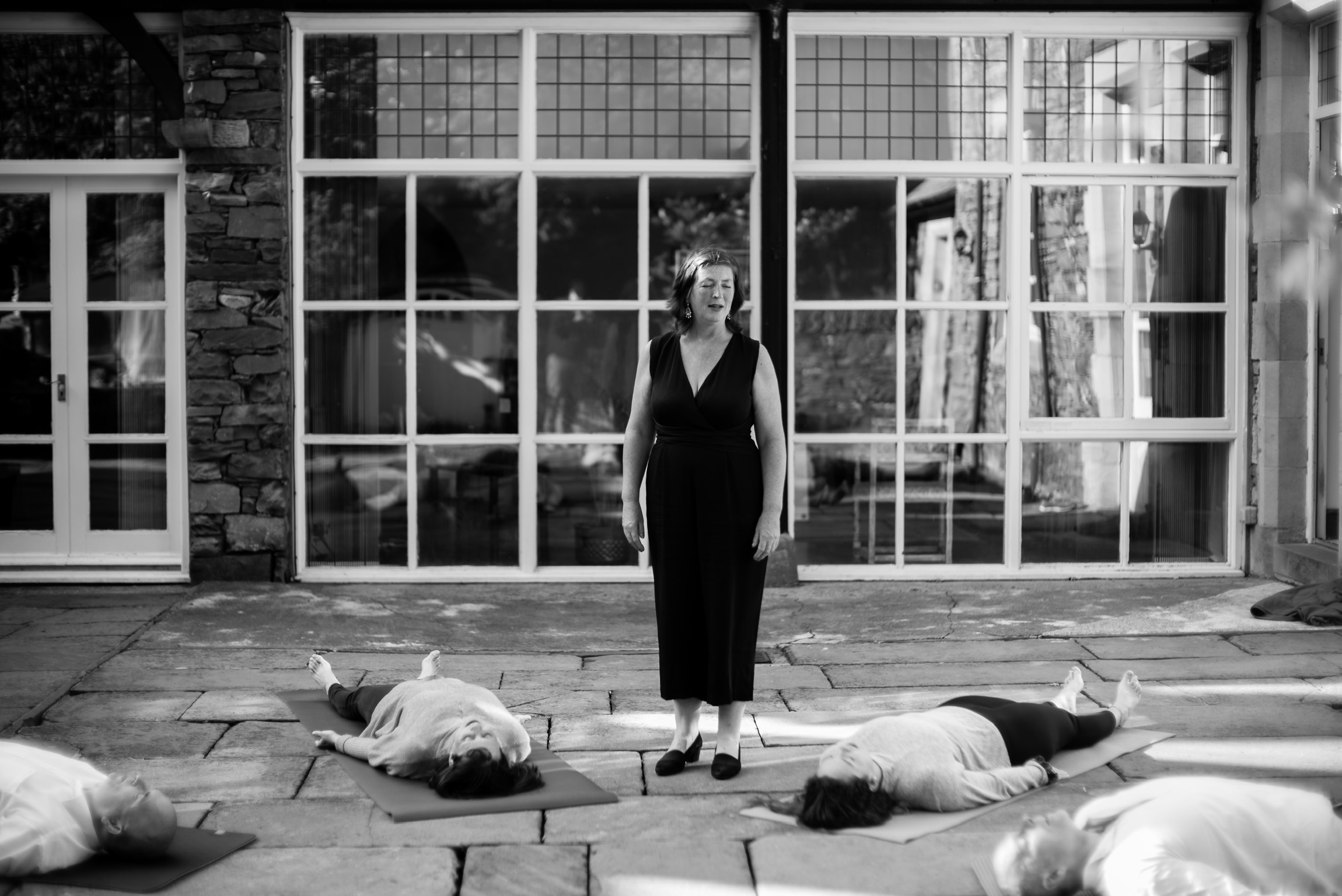
There's a particular kind of exhaustion that comes from a life spent just keeping up. The diary is full. The inbox is full. The mental list of things you haven't done yet is very, very full. Sleep is patchy. Downtime, if it exists at all, tends to feel like guilt dressed up as relaxation.
In that state, the deeper questions don't stand a chance. As Lucy puts it: if you can't sleep, if you're exhausted during the day, you're not going to be doing any real soul-searching. You're just surviving.
And survival mode, it turns out, is extremely efficient at keeping the big questions at bay. The nervous system is busy managing the next thing, and the next, and the next. There's no space for anything else to come through. Not clarity. Not purpose. Not the more honest version of yourself that might actually know what you need.
This isn't a personal failing - it's physiology. A nervous system that's been running on stress and adrenaline for years genuinely does not have the capacity to drop into reflective inquiry. The question "what is my purpose?" requires a kind of stillness that isn't available to someone who's constantly braced for the next demand.
So the first step isn't finding your purpose. It's creating enough space to be able to look.

"What is my purpose?" might be the wrong starting point
Here's something Lucy has observed across decades of working with students: most people who arrive searching for purpose are actually searching for themselves. They've been so busy becoming who other people needed them to be - the responsible one, the capable one, the one who holds everything together - that somewhere along the way, the question of who they actually are got lost entirely.
"What is my purpose?" is a meaningful question. But it assumes you already know who's asking. And for a lot of people, that's the part that's missing.
This is at the heart of what Lucy's work is built on. The Who Am I Quest isn't a tagline - it's the inquiry itself. Before the question of purpose can be answered with any real honesty, there has to be some investigation into the person doing the asking. Who are you, underneath the roles and the responsibilities and the identity you've accumulated? What's actually there, when everything else falls away?
That's the territory that self-inquiry opens up. And it turns out that for most people, it's the territory where purpose lives.
What self-inquiry meditation actually involves
Self-inquiry is a meditative practice rooted in a single, deceptively simple question: "Who am I?"
Not as a philosophical puzzle to be solved intellectually. Not as an exercise in listing your qualities or your roles. The question is asked inwardly, sincerely, and without expectation of a clever answer - because the point isn't to think your way to a conclusion. It's to follow the question beneath thought, to the source of the awareness that's doing the questioning.
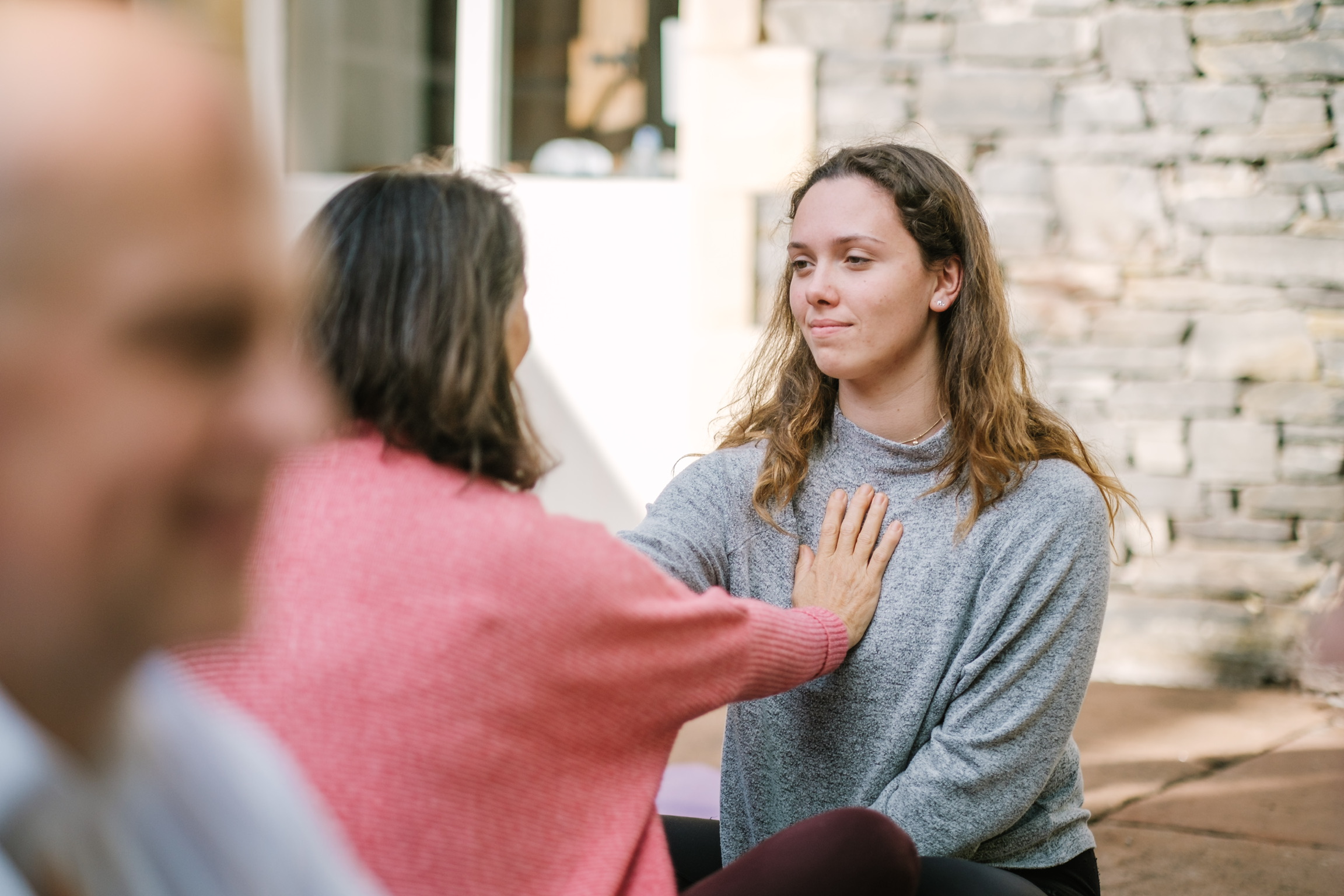
In practice, it looks something like this. You sit still. You bring your attention inward. You ask the question - not of your mind, which will immediately volunteer a list of your job titles and family roles and opinions about yourself, but of the aware presence that's watching all of that. And then you wait, without grasping.
What most people find, especially at first, is that the mind is very noisy. Thoughts about the shopping, the meeting, the thing that was said last Tuesday. This is normal, and it's not a problem. The practice isn't about silencing the mind, it's about becoming curious about what's underneath it.
Lucy has described it as learning to sit in the question rather than rushing to the answer. The inquiry itself, sustained over time, begins to loosen the fixed sense of identity that keeps people stuck. When you stop being so certain about who you are, there's suddenly room for something truer to emerge.
It's a practice that can feel strange at first, particularly if you've tried meditation before and found it frustrating. If that's your experience, it's worth reading our guide to how breathwork and meditation differ - the two practices work in complementary ways, and for some people, the body-based approach of breathwork is actually the easier entry point into stillness.
What happens when the noise settles
The students who come through Lucy's programmes don't tend to describe a single moment of revelation. Purpose, it turns out, doesn't usually announce itself with great fanfare. What people describe instead is a gradual shift - a growing sense of what they're drawn toward, what genuinely matters to them, what they keep returning to even when life gets difficult.
Often, it's simpler than they expected. Not a grand mission or a calling with capital letters. More like a recognition. Oh. This. This is what I'm actually here for.
Lucy's observation, after 30 years of this work, is that purpose doesn't have to be found so much as uncovered. It was already there. It just needed the internal racket to settle enough to become audible.
That shift, from surviving to actually being present to your own life, is what the practice makes possible. Not immediately, and not without some commitment. But reliably, for the people who stay with it.

Where do you even begin?
If you're reading this and thinking "I don't even know how to sit still for five minutes," you're in good company. Most people who come to Lucy's work have tried meditation before, decided they were bad at it, and given up. This is extremely common. It's also, as Lucy would say, a bit of a misunderstanding of what meditation actually is.
Meditation isn't about achieving a blank, peaceful mind. It's about learning to be present with whatever is actually happening, including the racing thoughts, the restlessness, and the mild suspicion that you're doing it wrong. The practice is in returning, not in staying.
A few practical things that help:
- Start shorter than you think you need to. Five minutes of genuine attention is worth more than 20 minutes of distracted fidgeting.
- Sit regularly rather than for long stretches. Consistency builds the capacity for stillness far more reliably than occasional long sessions.
- Don't start with self-inquiry. Build a foundation of basic meditation practice first - learning to sit, to breathe, to observe without getting swept up in every thought. Then the inquiry has somewhere to land.
If you want structure and guidance, Lucy's 3-Year Meditation Training Course runs on Tuesday evenings and is open now. It's a thorough, progressive training, not a drop-in class, and it covers exactly this ground: learning to sit, developing a sustainable practice, and beginning to work with self-inquiry in a supported way.
For those drawn to the body-based side of this work, Breath of Life is a 10-month breathwork and pranayama course beginning in October 2026. It sits beautifully alongside a meditation practice, you can read more about how the two complement each other in What Is Breathwork and What Does It Actually Do to Your Body?
You can also join the free Who Am I Quest community on Skool to get a feel for the work before committing to a course. Lucy runs live meditation sessions there regularly.

Frequently Asked Questions
Can meditation really help you find your purpose?
Meditation doesn't hand you a purpose, but it does create the conditions in which purpose can become clear. Most people are too busy, too stressed, or too stuck in their heads to hear what actually matters to them. A regular practice gradually strips back that interference, and what's left tends to be more honest. Many of Lucy's students describe a growing sense of clarity and direction as their practice deepens, not because meditation tells them what to do, but because it helps them hear themselves more clearly.
What is self-inquiry meditation?
Self-inquiry is a contemplative practice centred on the question "Who am I?" - asked inwardly, without rushing to an intellectual answer. Rather than focusing on the breath or a mantra, you turn attention toward the source of awareness itself. It's a practice rooted in the Advaita Vedanta tradition and was brought into modern consciousness largely through the teachings of Ramana Maharshi. Lucy teaches it as part of her 3-Year Meditation Training Course.
I feel lost in life. Is meditation the right place to start?
Feeling lost often comes from being disconnected from yourself, from years of adapting, coping, and getting on with things without stopping to ask what you actually want. Meditation can be a powerful place to start because it creates a space for that reconnection. It's not a quick fix, but for many people it becomes the most important thing they do for themselves.
How long does it take to find your purpose through meditation?
There's no honest answer to this in terms of weeks or months, because it depends entirely on the individual, their practice, and what they're carrying. What Lucy observes consistently is that the shift comes not from a single session but from accumulated practice - from showing up repeatedly and learning, over time, to be genuinely present to your own experience. For some people, clarity starts to emerge within months. For others it's a longer unfolding. Either way, the practice tends to be worthwhile long before the big questions are resolved.
What's the difference between meditation and breathwork for self-discovery?
Meditation tends to work primarily through the mind and awareness, you learn to observe thought, to sit in stillness, to investigate the nature of the self. Breathwork works through the body, conscious breathing techniques can shift the nervous system, release stored tension, and open up emotional blocks that sitting practice alone might not reach. The two approaches complement each other well. For a fuller comparison, see Breathwork vs Meditation: What's the Difference and Which One Do You Need?
Stay connected with news and updates!
Join our mailing list to receive the latest news and updates from our team.
Don't worry, your information will not be shared.
Author

Lucy Pattinson
Author
Lucy co-founded and is the director of Who Am I Quest. She runs 'The Breath of Life', 'The Who Am I? Series' and forgiveness courses and retreats. She has been a fully certified breath practitioner for over 30 years and a long-time member of the British Rebirth Society and the International Breathwork Foundation.